

How Wet Track Conditions
Change Racing Tire Traction

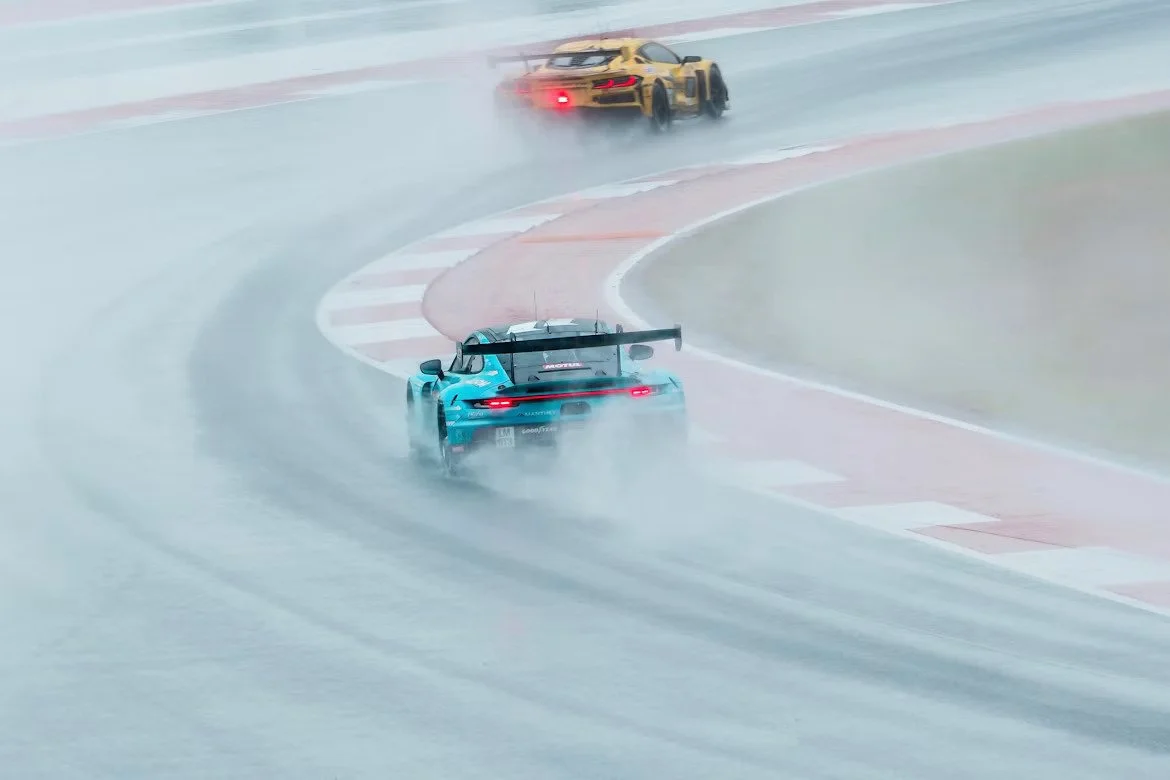
Racing on a wet track changes almost everything about how a car behaves. Tires that feel planted on dry asphalt can suddenly struggle for grip when water covers the racing surface. That change is not simply about driving slower. Wet conditions affect braking, cornering, acceleration, steering response, and tire temperature throughout a race.
The impact of wet conditions can also be seen on everyday roads, and in many cases, the outcomes are deadly.
According to the National Highway Traffic Safety Administration, tire-related crashes caused 511 fatalities nationwide in 2024. Reduced grip caused by worn rubber significantly lengthens overall stopping distances on wet pavement.
Proper maintenance of tire tread depth is essential for preventing dangerous sliding during adverse weather conditions. For racing drivers, in particular, tire choice becomes much more important when rain enters the equation.
Here are a few important ways wet track conditions change racing tire traction.
Water Reduces The Tire's Contact With Asphalt
Rocket League, which has around 1 million players, is one of the most popular crossover spaces. In this game, players use rocket-powered cars to play soccer in giant futuristic arenas. NASCAR brought its actual Next Gen cars right onto that pitch.
Players can slap authentic team paint schemes onto their vehicles. They can score an aerial goal while repping real race liveries and custom tire designs. It makes the sport feel cool, stylish, and full of action.
Then came Fortnite, which is far more than a battle royale. “Fortnite provides the perfect
Building Immersive Playgrounds and Racing Hubs on Roblox
A racing tire needs consistent contact with the track to generate dependable grip. When water sits between the tire and asphalt, that relationship becomes much less predictable.
Tread patterns help move water away from the contact patch, allowing more rubber to reach the surface. However, tires still have physical limits when water accumulates faster than they can disperse.
The result can be reduced traction during braking, acceleration, and even cornering. Drivers may notice the car feels lighter or less responsive, especially when entering corners at higher speeds.
Wet conditions also make the racing line more complicated. A line that provides excellent grip in dry weather may collect more water during heavy rain. Drivers therefore need to search for areas where the tires can maintain better contact. Small changes in positioning can sometimes make a noticeable difference to overall traction.
This is why wet-weather racing requires more than simply fitting tires designed for rain. Drivers must continuously read the track and adjust their approach.
Hydroplaning Can Cause Sudden Loss Of Control
Hydroplaning happens when water prevents a tire from maintaining sufficient contact with the surface of the road. Instead of gripping the asphalt properly, the tire begins riding across the water. This can produce an extremely sudden loss of steering, braking, or acceleration control. The risk generally becomes greater when vehicles travel quickly through deeper puddles.
Racing tires can be particularly vulnerable when conditions overwhelm their ability to move water away. Once hydroplaning begins, even an experienced driver may have limited time to react.
To understand the impact of such wet roads, you can look outside racing environments. A recent Toledo, Ohio crash involving Representative Marcy Kaptur illustrates how dangerous wet conditions can become. Police later alleged that the driver responsible for the crash was traveling at twice the speed limit during heavy rain before hitting a large puddle. The vehicle reportedly lost control, crossed the center line, and struck another vehicle, causing injuries.
In situations involving a car accident, lawyers can help injured people understand their legal options. A Toledo auto accident lawyer may investigate evidence, insurance issues, injuries, and other legal matters in the case discussed above. If the driver who crashed into Katpur’s car is found guilty of negligence, the lawyer will take necessary action.
Zoll & Kranz, LLC points out how an auto accident lawyer can also help clients communicate with insurers and pursue appropriate compensation after serious car accidents. Personal injury lawyers may assist when injuries create medical expenses, lost income, or other damages.
On the race tracks, wet roads and hydroplaning can lead to similar accidents. Drivers and their teams, thus, need to be very observant of the roads as they go out on their runs.
Braking Performance Becomes Less Consistent
Braking is one of the first areas where drivers notice major differences between wet and dry tracks. Water reduces the friction available between the tires and racing surface. That means drivers often need more distance to slow the car effectively. Braking too aggressively can overwhelm the available grip and end up locking the tires.
Modern racing vehicles may have sophisticated braking systems, but technology cannot completely eliminate the limitations created by standing water. The challenge becomes even greater when a driver approaches a corner after reaching high speed. The available braking window becomes narrower when traction levels are constantly changing.
Wet conditions can also make braking zones inconsistent throughout the circuit. Some areas may remain relatively grippy while others become extremely slippery after repeated rainfall.
Drivers therefore need to make constant adjustments rather than relying entirely on familiar braking markers. Feeling how the tires respond becomes just as important as following established reference points. Tire temperature also matters during this process. If tires fail to reach their intended operating range, their grip can decline even further.
That combination makes smooth braking especially valuable during wet races. Gradual inputs can help preserve traction and keep the car balanced.
Cornering Grip Becomes Harder To Predict
Cornering depends heavily on the tires maintaining enough lateral grip to keep the vehicle following its intended path. Wet conditions can make that grip inconsistent from one moment to another.
A driver may enter a corner expecting a certain level of traction and discover that the surface offers considerably less grip. Small changes in water depth can produce surprisingly different handling characteristics. This uncertainty affects steering inputs as well. Sharp steering movements can overwhelm available traction and cause the vehicle to understeer or oversteer.
Official race coverage from the International Motor Sports Association (IMSA) documented severe weather during the 2025 Sahlen's Six Hours of the Glen. The circumstances forced teams to switch from slick compounds to dedicated wet-weather tires.
Water accumulation on the track dramatically reduced available lateral cornering grip during the event. Precise tire selection proved vital for maintaining vehicle balance on unpredictable turning lines.
Cornering Grip Becomes Harder To Predict
Cornering depends heavily on the tires maintaining enough lateral grip to keep the vehicle following its intended path. Wet conditions can make that grip inconsistent from one moment to another.
A driver may enter a corner expecting a certain level of traction and discover that the surface offers considerably less grip. Small changes in water depth can produce surprisingly different handling characteristics. This uncertainty affects steering inputs as well. Sharp steering movements can overwhelm available traction and cause the vehicle to understeer or oversteer.
Official race coverage from the International Motor Sports Association (IMSA) documented severe weather during the 2025 Sahlen's Six Hours of the Glen. The circumstances forced teams to switch from slick compounds to dedicated wet-weather tires.
Water accumulation on the track dramatically reduced available lateral cornering grip during the event. Precise tire selection proved vital for maintaining vehicle balance on unpredictable turning lines.
Smoothness becomes especially important when the track remains wet for extended periods. Drivers often need to make smaller steering adjustments while carrying less speed through corners. Track temperature can further complicate matters. Cooler surfaces may prevent tires from reaching their ideal operating temperatures, reducing available grip.
The type of racing tire also plays a major role. Wet-weather compounds are designed to work differently from slick tires, which depend heavily on dry surfaces. Choosing the right tire therefore involves more than simply checking whether rain is falling. Teams must consider rainfall intensity, surface temperature, water depth, and expected track conditions.
Good tire strategy can help drivers maintain confidence while conditions continue changing. Poor tire selection can leave even a talented driver fighting the car throughout every corner.
Acceleration Requires Much Smoother Inputs
Wet conditions do not only affect braking and cornering. They also make putting power down onto the track considerably more difficult. When a driver accelerates aggressively, the driven tires can lose traction and begin spinning. This wheelspin wastes available grip and can make the car unstable.
The problem becomes particularly noticeable when exiting slow corners. Drivers often have significant engine power available, but the wet surface cannot always handle that force. Smooth throttle application helps the tires gradually build traction. Applying power too quickly can break the tires loose before the vehicle has straightened.
Electronic traction control can sometimes help manage wheelspin, depending on the racing series and vehicle regulations. However, drivers still need to understand how much grip remains available.
Wet surfaces also make acceleration zones less predictable. Puddles, painted surfaces, rubber buildup, and changing water levels can all affect traction. A driver who feels strong grip at one point may encounter dramatically different conditions a few meters later. That requires constant attention to steering feedback and throttle response.
The best approach is usually controlled rather than aggressive. Preserving traction through the exit can ultimately produce a faster and more stable lap.
FAQs
What role does tire compound softness play in generating grip on a rain-soaked track?
Softer racing compounds can conform more closely to wet track surfaces, helping maintain mechanical grip when conditions are challenging. However, excessive softness can increase overheating and wear, particularly as track conditions change. Wet-weather tire compounds are specifically designed to balance flexibility, water displacement, temperature management, and predictable traction.
How do racing drivers generate and maintain tire temperature in wet track conditions?
Drivers can build tire temperature through controlled acceleration, braking, and steering inputs while avoiding excessive wheelspin or sliding. Wet conditions make warming tires particularly difficult because reduced friction generates less heat. Teams also use appropriate tire pressures, compounds, and preparation techniques to help tires reach and maintain their effective operating range.
What is the ideal racing line on a wet track compared to a dry track?
The ideal wet racing line often differs from the dry line because rubber buildup can become extremely slippery when covered with water. Drivers may use a wider line that avoids the heavily rubbered surface and offers better drainage. They also adjust braking points, cornering speeds, and steering inputs to maintain stability and maximize available grip.
Wet track conditions fundamentally change the relationship between racing tires and the surface beneath them. Water can reduce contact, increase hydroplaning risks, weaken braking performance, and complicate cornering.
Acceleration also becomes more demanding because tires can easily lose grip when too much power reaches the wheels. These changes require drivers to adjust their techniques instead of relying on dry-track habits.
Tire selection becomes equally important because different compounds and tread designs respond differently to changing conditions. Teams must consider weather, track temperature, water depth, and the expected duration of rainfall.
For drivers, the biggest lesson is simple. Wet racing rewards patience and precision. Smooth steering, controlled braking, and gradual acceleration can help preserve whatever traction remains. When the track becomes wet, respecting the tires often becomes the key to staying in control.
